
Every GST invoice shows tax as either CGST + SGST or IGST — and if you’re new to GST, it can be confusing which one to use. The good news: there’s just one simple rule behind it. This guide explains CGST, SGST and IGST in plain language, with a worked example.
The one rule that explains everything
Same state → CGST + SGST. Different state → IGST.
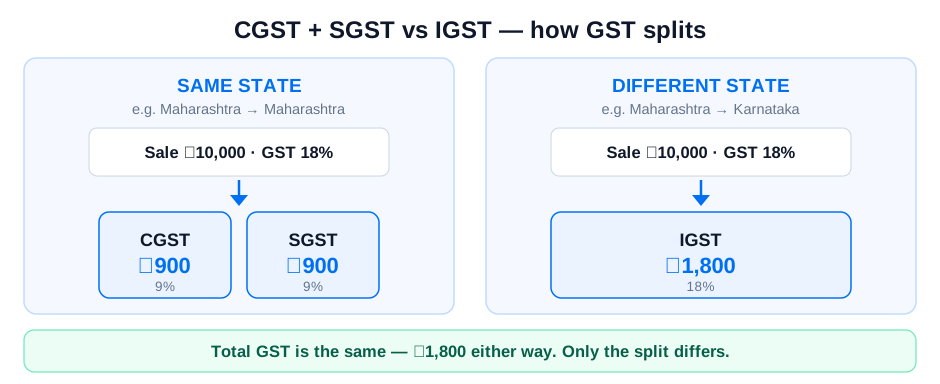
That’s it. Whether you charge one combined tax (IGST) or a split of two (CGST + SGST) depends only on whether your customer is in the same state as the sale or a different one. The total tax amount is exactly the same either way — only the split changes.
What CGST, SGST and IGST stand for
GST is shared between the Central Government and the State Government. The three names simply tell you who gets which share:
| Tax | Full form | Collected by |
|---|---|---|
| CGST | Central GST | Central Government |
| SGST | State GST | State Government |
| IGST | Integrated GST | Central Government (then shared with the buyer’s state) |
There’s also UTGST (Union Territory GST), which takes the place of SGST for sales inside a Union Territory without its own legislature. It behaves just like SGST.
Which one applies — and when
| Type of sale | Meaning | GST you charge |
|---|---|---|
| Intra-state | Buyer is in the same state as the sale | CGST + SGST (rate split in half) |
| Inter-state | Buyer is in a different state | IGST (full rate) |
So on an 18% item, an intra-state sale is 9% CGST + 9% SGST, while an inter-state sale is 18% IGST.
A simple example (₹10,000 sale at 18%)
Say you sell goods worth ₹10,000 at an 18% GST rate. The tax is ₹1,800 in both cases — watch how only the split changes:
| Scenario | Split | Tax | Invoice total |
|---|---|---|---|
| Same state (e.g. Maharashtra → Maharashtra) | CGST ₹900 + SGST ₹900 | ₹1,800 | ₹11,800 |
| Different state (e.g. Maharashtra → Karnataka) | IGST ₹1,800 | ₹1,800 | ₹11,800 |
Notice the customer pays the same ₹11,800 either way. CGST/SGST/IGST is just about how the government splits that ₹1,800 — not about charging more.
Why does GST split like this?
GST is a destination-based tax — the revenue is meant to go to the state where the goods or services are finally consumed. For a sale within your state, the split is easy: half to the Centre (CGST), half to your State (SGST). For a sale across state lines, the Centre collects the whole thing as IGST and then passes the state’s share to the destination state. It’s a settlement mechanism working quietly in the background — you only need to remember the one rule above.
How do you know which one to use?
It comes down to the place of supply — usually where your customer is located:
- Customer in your state → CGST + SGST.
- Customer in another state → IGST.
A common mistake is assuming it depends on where your business is registered. It doesn’t — it depends on where the sale is delivered.
You don’t have to calculate this by hand
The best part: you never need to work out the split manually. In KhataBuddy, you just add the customer and the item — the software checks the states and automatically applies CGST + SGST or IGST at the correct rate, and shows it cleanly on the invoice. Try KhataBuddy free and let it handle the GST split for you.
Related reading
- GST Rates in India 2026: The New GST 2.0 Slabs Explained
- What Is an HSN Code?
- Work out the tax on any amount with the GST Calculator.