
If you sell goods in India, you’ll see HSN codes on your invoices and GST returns. This guide explains what they are, how they’re structured, how many digits you need, and how to find the right one for your product.
What is an HSN code?
HSN stands for Harmonized System of Nomenclature — a globally standardised system for classifying goods using numeric codes. It was developed by the World Customs Organization (WCO) and is used by more than 200 countries, covering over 5,000 groups of products.
Under GST in India, every product is mapped to an HSN code. That code identifies the product on invoices and returns and helps apply the correct tax rate. Services use a parallel system called SAC (Services Accounting Code).
In short: HSN answers the question “what exactly is being sold?” in a way the tax system understands.
How an HSN code is structured
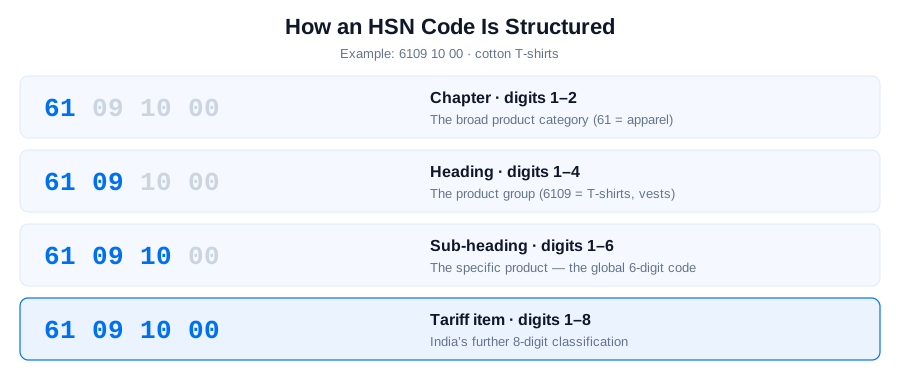
An HSN code is built up in layers — each pair of digits narrows down the classification:
| Digits | Level | What it identifies |
|---|---|---|
| First 2 | Chapter | The broad product category |
| First 4 | Heading | The product group within the chapter |
| First 6 | Sub-heading | The specific product (international standard) |
| First 8 | Tariff item | India’s further sub-classification |
So a longer code simply means a more precise description of the same product.
How many digits do you need?
The number of digits you must show on a GST invoice depends on your annual turnover:
| Annual turnover | HSN digits required |
|---|---|
| Up to ₹5 crore | 4 digits |
| Above ₹5 crore | 6 digits |
| Imports / exports | 8 digits |
Always confirm the requirement that currently applies to your business.
Common HSN code examples
Here are a few everyday products and their HSN headings (first 4 digits) to give you a feel for it:
| Product | HSN heading |
|---|---|
| Rice | 1006 |
| Cotton T-shirts | 6109 |
| Mobile phones | 8517 |
| Medicines | 3004 |
| Footwear | 6403 |
| Furniture | 9403 |
These are examples only — confirm the exact 6- or 8-digit code for your specific product with the HSN Code Finder.
Why HSN codes matter
- They’re mandatory on GST invoices for goods (SAC for services).
- They ensure the correct GST rate is applied to each item.
- They keep your GSTR-1 and GSTR-3B filings consistent and error-free.
- Buyers rely on them to claim the right input tax credit.
Where the HSN code appears on a GST invoice
On a GST invoice, the HSN/SAC code sits alongside each line item — next to the description, quantity, rate and taxable value — before the CGST/SGST or IGST split. Getting it right keeps the whole invoice compliant.
What if you use the wrong HSN code?
Using an incorrect HSN code can lead to the wrong GST rate, mismatches in your returns, and — in some cases — notices or penalties. It also causes friction for your customers claiming input tax credit. The safest habit is to confirm the code once and reuse it.
How to find the right HSN code
The quickest way is to search by product name or code:
- Use the free HSN Code Finder — type a product (e.g. “leather”, “mobile phone”) or a code, and it returns matching HSN/SAC codes with descriptions.
- Need the tax on it too? The GST Calculator works out CGST/SGST/IGST on any amount.
Inside KhataBuddy, the right HSN/SAC code and GST rate are suggested automatically as you add items — so you never have to look them up manually while billing. Try KhataBuddy free to keep every invoice compliant without the guesswork.