
If you sell or buy mobile phones, laptops or home appliances, two questions come up on every bill: what is the HSN code, and how much GST applies? The short answer: the mobile HSN code is 8517 and the GST rate is 18%. This guide gives the full HSN code and GST rate list for phones, accessories and electronics, what changed under GST 2.0, and when a business can claim input tax credit.
HSN code for mobile phones
The HSN code for mobile phones is 8517 — the heading that covers telephones for cellular networks. At the more specific 8-digit level, smartphones are classified as 8517 13 00.
| Item | HSN code | GST rate |
|---|---|---|
| Mobile phone / smartphone | 8517 (8517 13 00) | 18% |
| Mobile phone parts | 8517 | 18% |
| Mobile charger | 8504 | 18% |
| Earphones / headphones | 8518 | 18% |
| Power bank | 8507 | 18% |
| Data / USB cable | 8544 | 18% |
| Memory card | 8523 | 18% |
| Laptop / desktop | 8471 | 18% |
Mobile HSN code and GST rate together: put 8517 on the invoice line and charge 18% GST — that combination covers the vast majority of phone sales.
How many digits you need to show depends on your turnover: typically 4 digits up to ₹5 crore, 6 digits above it, and 8 digits for imports and exports. See What Is an HSN Code? for how the digits are structured, and confirm the exact code for a specific model or accessory with the free HSN Code Finder.
GST rate on mobile phones
Mobile phones attract 18% GST, classified under HSN heading 8517. This is a single, uniform rate across the country — it applies to budget feature phones and premium smartphones alike, and it doesn’t change from state to state.
Here’s how it works on a typical sale:
| Amount | |
|---|---|
| Phone price (taxable value) | ₹20,000 |
| GST @ 18% | ₹3,600 |
| Invoice total | ₹23,600 |
Whether the tax shows as CGST + SGST or IGST depends only on where the customer is:
- Same state (e.g. Maharashtra → Maharashtra): ₹1,800 CGST + ₹1,800 SGST.
- Different state (e.g. Maharashtra → Karnataka): ₹3,600 IGST.
The customer pays the same ₹23,600 either way — see CGST, SGST & IGST explained for why the split changes.
GST on other electronics
Under GST 2.0 (effective 22 September 2025), the old 28% slab was removed. Large televisions, air conditioners and dishwashers — which used to be taxed at 28% — now sit at 18%, in line with the rest of the electronics category. That makes the picture refreshingly simple: almost all consumer electronics are 18%.
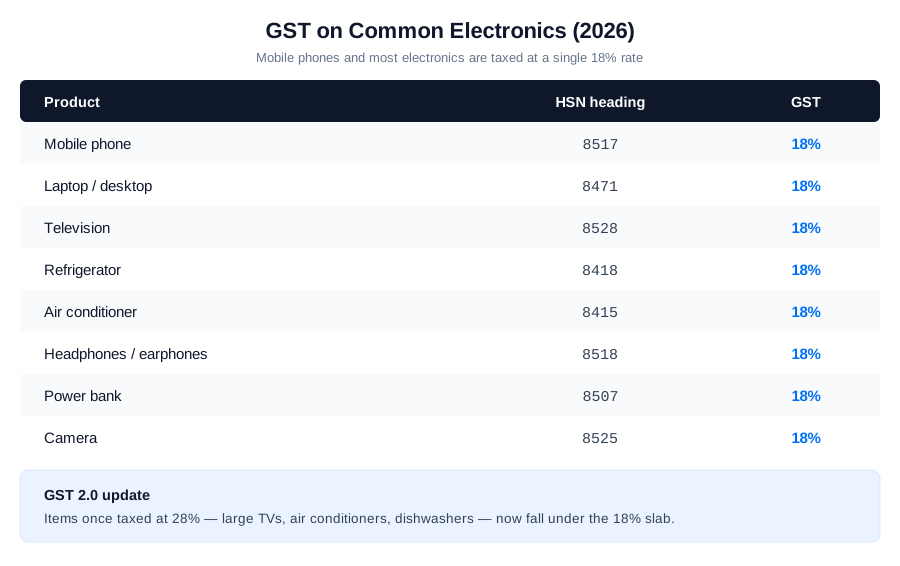
| Product | HSN heading | GST |
|---|---|---|
| Mobile phone | 8517 | 18% |
| Laptop / desktop | 8471 | 18% |
| Television | 8528 | 18% |
| Refrigerator | 8418 | 18% |
| Air conditioner | 8415 | 18% |
| Headphones / earphones | 8518 | 18% |
| Power bank | 8507 | 18% |
| Camera | 8525 | 18% |
These are heading-level codes — confirm the exact 6- or 8-digit code for a specific product with the free HSN Code Finder.
What about chargers and accessories?
This is where sellers often get confused:
- A charger sold inside the phone box is part of the phone — a composite supply — so the whole package is taxed at the phone’s 18%.
- Standalone accessories sold separately — chargers, earphones, cases, screen guards, power banks — are taxed at 18% in their own right.
So in practice, the mobile-retail counter runs almost entirely on one rate: 18%.
Can a business claim input tax credit?
Yes. If you’re a GST-registered business, you can claim input tax credit (ITC) on phones, laptops and other electronics bought for business use — reducing the GST you owe on your own sales. Two conditions matter:
- You must hold a valid tax invoice showing your GSTIN.
- The item must be used for business, not personal use.
For a mobile or electronics dealer, ITC on your purchase stock is central to how GST works — you pay 18% to your supplier, collect 18% from your customer, and remit only the difference.
Billing electronics correctly
For electronics retailers, a compliant bill isn’t just about the 18% rate — it’s about capturing the HSN code, the IMEI or serial number, and the right CGST/SGST or IGST split on every device. Doing that by hand is slow and error-prone.
In KhataBuddy, you add the item and the software applies the correct HSN code and 18% GST rate automatically, tracks IMEI/serial numbers for each unit, and generates a clean GST invoice you can share on WhatsApp. See how it works for mobile & electronics businesses, or try KhataBuddy free.
Need a quick one-off bill? Use the free GST Invoice Generator, or work out the tax on any amount with the GST Calculator.