
Pharmacies deal with a mix of GST rates every day — most medicines sit at one rate, a set of critical drugs at another. The short answer: most medicines are taxed at 5%, and specified life-saving drugs at 0%. This guide explains the rates, what changed under GST 2.0, the HSN codes, and how a chemist claims input tax credit.
GST rate on medicines
Most medicines are taxed at 5% GST, under HSN headings 3003 and 3004. This covers the bulk of what a pharmacy sells — tablets, syrups, injections and other formulations in retail packing.
Under GST 2.0 (effective 22 September 2025), most medicines were reduced from the old 12% slab to 5%, making essential medicines cheaper for patients.
Life-saving drugs at 0%
Alongside the 5% rate, the government notified a set of specified life-saving drugs — such as select cancer and rare-disease medicines — at 0% (nil). These are exempt so that critical treatment costs less. The list is specific and set by notification, so check whether a particular drug qualifies rather than assuming.
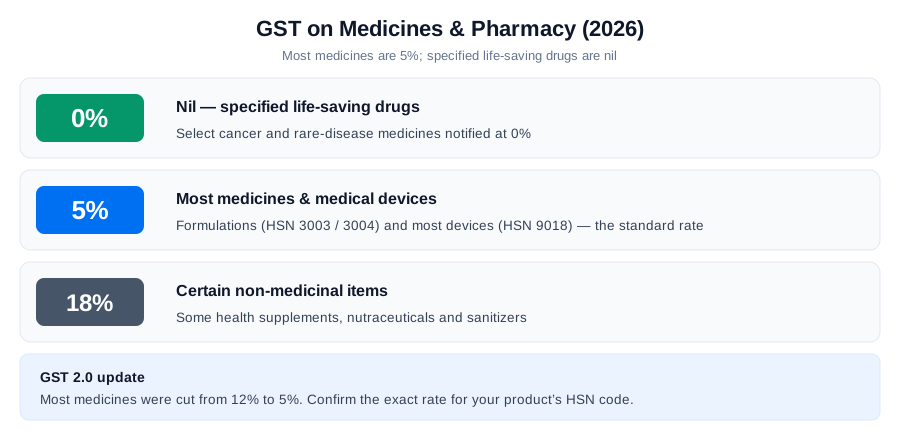
GST rates across pharmacy items
| Item | Typical GST rate |
|---|---|
| Specified life-saving drugs | 0% |
| Most medicines / formulations (HSN 3003, 3004) | 5% |
| Vaccines (HSN 3002) | 5% |
| Medical devices & apparatus (HSN 9018) | 5% |
| Bandages, gauze, dressings (HSN 3005) | 5% |
| Some health supplements / non-medicinal items | 18% |
These are the widely-applied rates — because pharma classifications are specific and can be revised, confirm the exact rate for each product with the HSN Code Finder before billing.
HSN codes for pharmacy
| Item | HSN heading |
|---|---|
| Medicaments (retail / measured doses) | 3004 |
| Other medicaments | 3003 |
| Vaccines, blood | 3002 |
| Bandages, wadding, gauze | 3005 |
| Medical instruments & apparatus | 9018 |
Can a pharmacy claim input tax credit?
Yes. A GST-registered pharmacy or chemist can claim input tax credit (ITC) on medicines and supplies bought for resale. You pay GST to your distributor, collect GST from customers, and remit only the difference. The requirement is a valid tax invoice from your supplier showing the GSTIN — so keep purchase invoices in order.
Note that where you sell 0%-rated medicines, there’s no output GST to collect, but you can still deal in them normally; your billing must simply show the nil rate correctly.
Billing a pharmacy correctly
Pharmacy billing has its own demands — batch numbers and expiry dates, the right HSN code and 5% or 0% rate per item, and clean records for stock and returns. Doing this by hand is slow and error-prone.
In KhataBuddy, you can bill with batch and expiry tracking, apply the correct HSN code and GST rate automatically for each medicine, and share a compliant invoice on WhatsApp. See how it works for pharmacy businesses, or try KhataBuddy free.
Need a quick calculation? The GST Calculator works out the tax on any amount.