
If you sell to other businesses, one question decides whether e-invoicing is your problem or somebody else’s: the turnover limit. The short answer is ₹5 crore — but the way that limit is tested surprises a lot of people, and it is the part worth getting right.
The e-invoice turnover limit
E-invoicing applies to GST-registered businesses whose aggregate annual turnover is above ₹5 crore. Cross that, and your B2B invoices must be registered with the government’s Invoice Registration Portal (IRP) before they count as valid tax invoices.
That much is widely known. The next part is not.
The rule that catches people out
The test is not “is my turnover above ₹5 crore this year?”
It is: did my aggregate turnover cross ₹5 crore in any financial year from 2017-18 onwards?
| What people assume | What the rule actually says |
|---|---|
| Based on the current year’s turnover | Based on any year since 2017-18 |
| Falls away if turnover drops | Once you cross it, the obligation stays |
| Checked afresh each year | Tied to your highest past turnover |
So a business that touched ₹6 crore in 2022-23 and has since settled back to ₹4 crore is still within e-invoicing. If you have ever been above the line, assume you are in scope and confirm rather than going by this year’s books.
Which supplies actually need one
E-invoicing is about who you sell to, not just how much you sell.
| Type of supply | E-invoice needed? |
|---|---|
| B2B — sale to a GST-registered business | Yes |
| Exports | Yes |
| Supplies to SEZ units | Yes |
| Deemed exports | Yes |
| B2C — sale to an unregistered consumer | No |
That last row matters more than it looks. A retail shop billing walk-in customers is doing B2C business, so e-invoicing does not apply to those sales however large the shop gets. It is wholesalers, distributors, manufacturers and service providers billing other businesses who need to watch the limit.
Who is exempt, even above the limit
Some categories sit outside e-invoicing regardless of turnover:
- Banks and financial institutions
- Insurance companies
- NBFCs
- Goods transport agencies (GTA)
- Passenger transport services
- SEZ units
If your business is one of these, the ₹5 crore line does not bring you into scope.
Three checks, in order
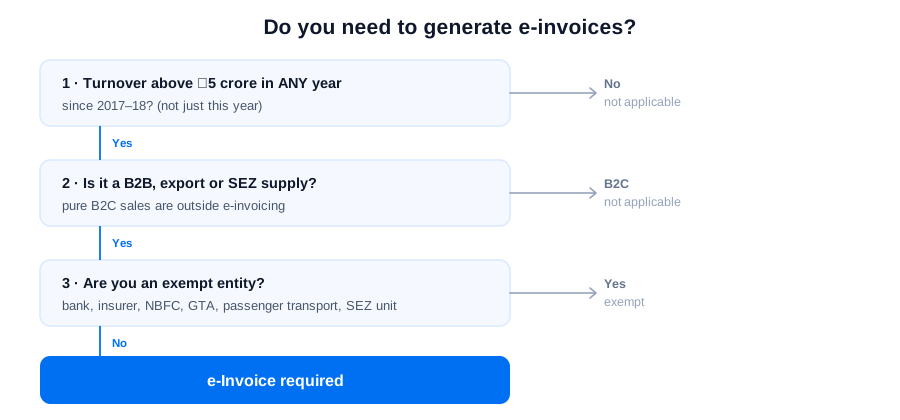
Putting it together, whether you need to generate e-invoices comes down to three questions:
The limit has only ever moved one way
E-invoicing did not arrive all at once. It started with the largest businesses and worked downwards:
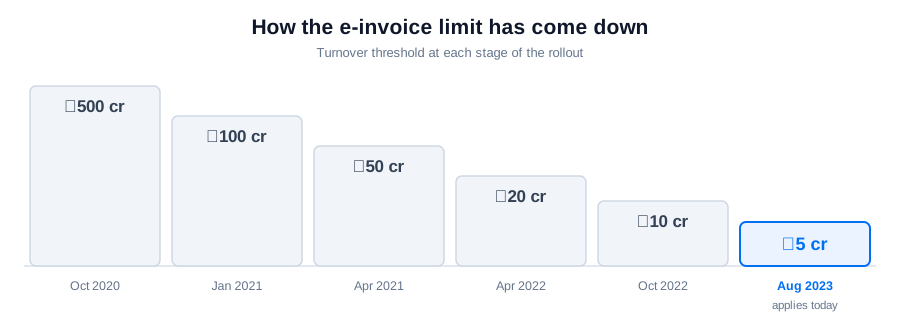
| From | Applied to turnover above |
|---|---|
| 1 October 2020 | ₹500 crore |
| 1 January 2021 | ₹100 crore |
| 1 April 2021 | ₹50 crore |
| 1 April 2022 | ₹20 crore |
| 1 October 2022 | ₹10 crore |
| 1 August 2023 | ₹5 crore |
Every revision has lowered the bar. If you are comfortably below ₹5 crore today, the sensible reading is not yet rather than never — and it is easier to be ready than to be caught out.
The 30-day reporting window
There is a second rule that applies to larger businesses. If your aggregate turnover is ₹10 crore or above, an invoice must be reported to the IRP within 30 days of the invoice date. Miss that window and the portal will not accept it — leaving you holding an invoice that cannot be made valid.
Below ₹10 crore this time limit does not currently apply, but the same advice holds: reporting as you bill is a great deal simpler than reporting in batches and discovering a gap.
What you get back
Registering an invoice is not a new document — it is your tax invoice, run past the government’s system. What comes back is:
- an IRN (Invoice Reference Number), a unique 64-character reference
- an Ack No and acknowledgement date
- a digitally signed QR code
All three must appear on the copy your buyer receives. See What Is a Tax Invoice? for the fields every GST invoice needs before any of this applies.
What happens if you skip it
An invoice that should have been registered and was not is not a valid tax invoice. The consequence lands in two places: your buyer can struggle to claim input tax credit against it, and non-compliance is liable to penalty under GST law. In practice the buyer-side friction bites first — B2B customers tend to notice quickly when an invoice cannot support their credit.
Worth confirming: thresholds, exemptions and reporting windows are set by notification and have been revised several times. Treat this as the shape of the rules, and confirm the specifics that apply to your business before relying on them.
Making e-invoices without the portal
If you are in scope, the practical question becomes how to register every B2B invoice without turning it into a daily chore of logging into the IRP and copying numbers back onto your paperwork.
That is what e-invoice software is for — you raise the invoice as usual and the IRN, Ack No and signed QR come back onto the bill automatically, with no separate upload. In KhataBuddy it runs on the same setup as e-way bills, so one registration covers both.