
If you pack anything for retail sale — your own product, or bulk stock broken down into smaller units — the label is not just marketing. India’s Legal Metrology (Packaged Commodities) Rules set out what a retail package must declare, and the list is longer than most people expect.
First: do the rules apply to you?
This is the question to settle before worrying about the label itself. The declarations apply to pre-packaged commodities — goods sealed before the sale, in a predetermined quantity the buyer does not see being measured.
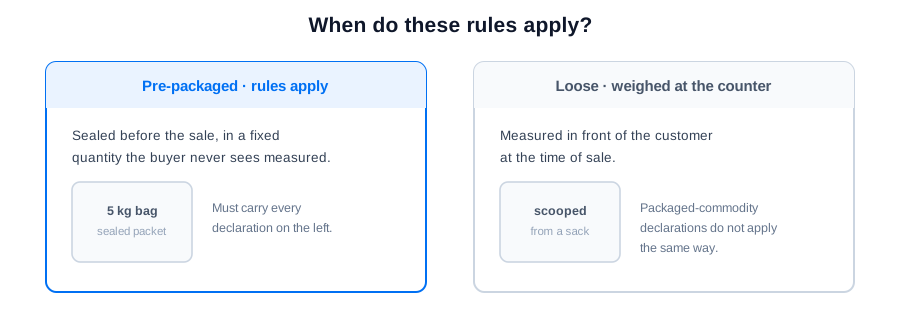
So a 5 kg bag of rice sealed in your back room is a packaged commodity. Rice scooped from a sack and weighed in front of the customer is not the same situation — you still bill it properly, but the package declarations are not what governs that sale.
The distinction matters because plenty of small businesses fall on the wrong side of it without noticing: the moment you start pre-packing bulk stock into retail units, you are packing for retail sale. The rules are not only for large manufacturers.
What a retail package must declare
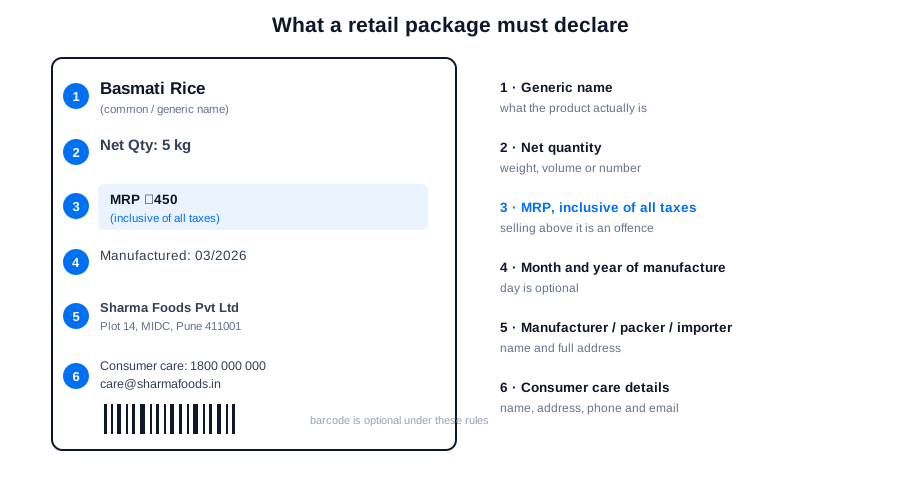
| # | Declaration | Notes |
|---|---|---|
| 1 | Common or generic name | What the product actually is, not only a brand name |
| 2 | Net quantity | Weight, volume or number — the contents, not the packaging |
| 3 | Maximum retail price | Inclusive of all taxes |
| 4 | Month and year of manufacture | Day is optional |
| 5 | Manufacturer / packer / importer | Name and complete address |
| 6 | Consumer care details | Responsible person or office, address, phone and email |
For imported goods, add the importer’s name and address and the country of origin — usually printed as “Made in [Country]”.
The MRP wording matters
MRP is not simply a price printed on a pack. It has to be declared as a maximum retail price inclusive of all taxes, and that phrase is doing real work:
- Nothing may be added on top at the counter. The printed figure already contains the tax.
- Selling above MRP is an offence. A “cooling charge” on a chilled bottle above the printed price is exactly the practice this rule exists to stop.
- Selling below MRP is fine. It is a ceiling, not a fixed price — which is why discounts are perfectly legal.
Since the MRP already includes tax, it is worth being clear how that relates to your GST working: the MRP is the tax-inclusive figure the customer pays, while your invoice shows the taxable value and the tax separately. See GST rates in India if you need the current slabs, and the GST Calculator to split an inclusive amount.
Other things worth knowing
Dates. The month and year of manufacture must appear. The day is optional. Food products carry a separate set of requirements of their own, including expiry or best-before marking.
Language. Declarations are expected in Hindi or English, and many packs carry both plus the regional language where the product is sold.
Legibility. The declarations are meant to be readable by an ordinary buyer — printed clearly, on a part of the pack the customer can actually see, not hidden in a fold or under a seal.
A barcode is not required. It is not one of the mandatory declarations. It appears on packs because it makes billing and stock tracking faster, which is a business decision rather than a legal one.
Worth confirming: the Legal Metrology rules are detailed, and additional requirements apply to particular categories — food, cosmetics, electronics and others each carry their own. Treat this as the general shape and confirm what applies to your specific product before printing a run.
Printing labels that carry all of this
Once you know what has to be on the pack, the practical problem is producing labels that carry it consistently — with the MRP and product name changing per item, and your business details staying the same on every one.
That is exactly what barcode label printing is for. You design the label once with your fixed details — brand name, consumer care line — and drop in fields that fill themselves from the item you select, including its name, code and MRP. Save it as a template, pick an item, set the number of copies and print.
Because the labels are generated from the items already in your inventory, the MRP on the sticker is the MRP in your system — which removes the most common cause of a shelf price and a billed price disagreeing.